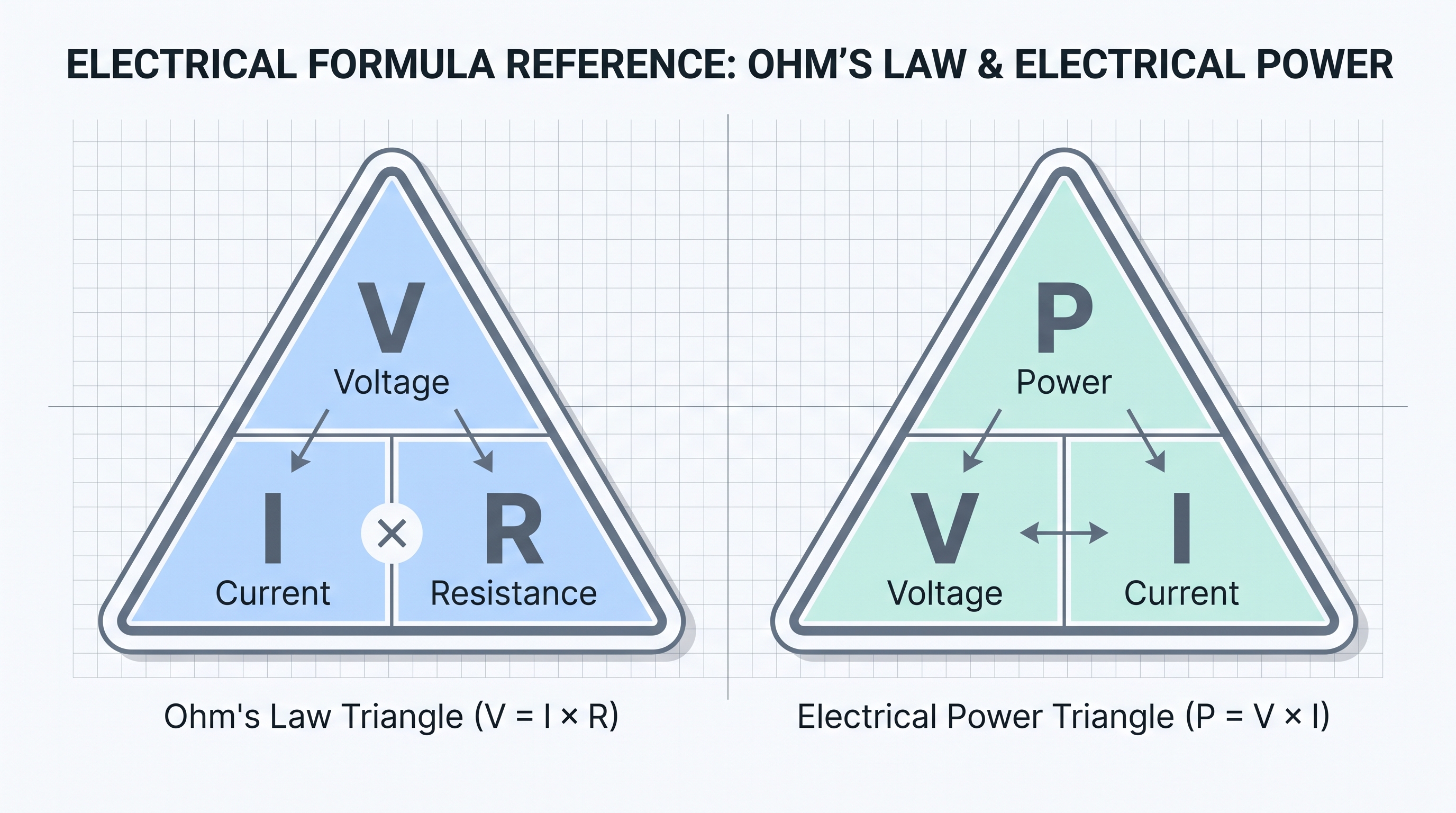
Ohm's Law is one of the most fundamental relationships in electrical engineering. It connects three important electrical quantities: voltage, current, and resistance.
Engineers, technicians and students use Ohm's Law for circuit analysis, electrical calculations, troubleshooting, component selection and basic system design.
What Is Ohm's Law?
Ohm's Law states that the current flowing through an approximately ohmic conductor is proportional to the voltage applied across it when relevant physical conditions remain sufficiently constant.
The basic equation is:
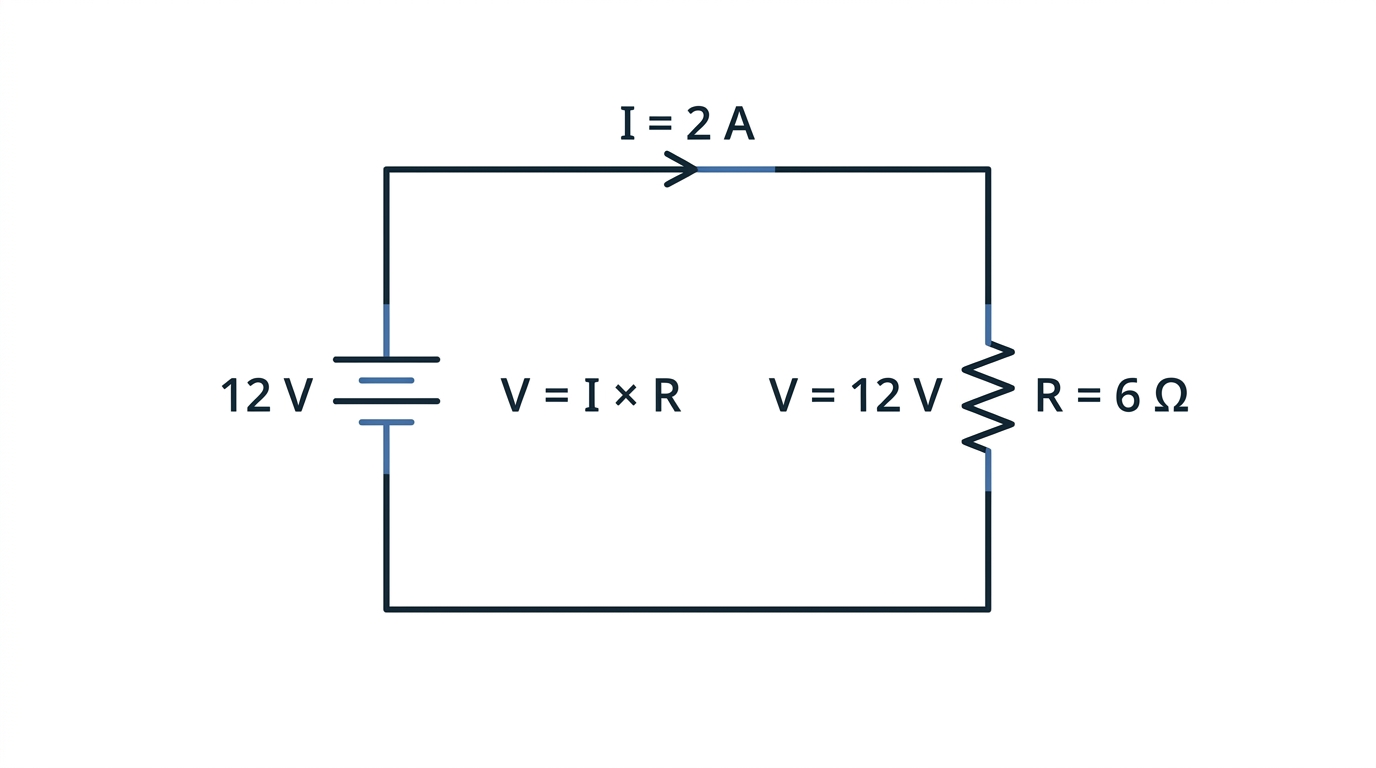
The three quantities are:
- V = Voltage, measured in volts (V)
- I = Current, measured in amperes (A)
- R = Resistance, measured in ohms (Ω)
Ohm's Law Calculator
Enter the two known values and calculate the third quantity.
I = V ÷ R
If the voltage is 12 V and the resistance is 6 Ω, the resulting current is 2 A.
Ohm's Law Formulas
Rearranging the basic equation allows you to calculate any one of the three quantities when the other two are known.
Understanding Voltage, Current and Resistance
Voltage
Voltage is the electrical potential difference between two points. It provides the potential that drives charge through a circuit.
Voltage is measured in volts (V).
Current
Electric current is the rate at which electric charge flows through a conductor.
Current is measured in amperes (A).
Resistance
Electrical resistance describes the opposition to current flow through a material or component.
Resistance is measured in ohms (Ω).
Practical Examples of Ohm's Law
Example 1: Calculate Current
Suppose a 12 V DC power supply is connected to a 6 Ω resistor. What current flows through the resistor?
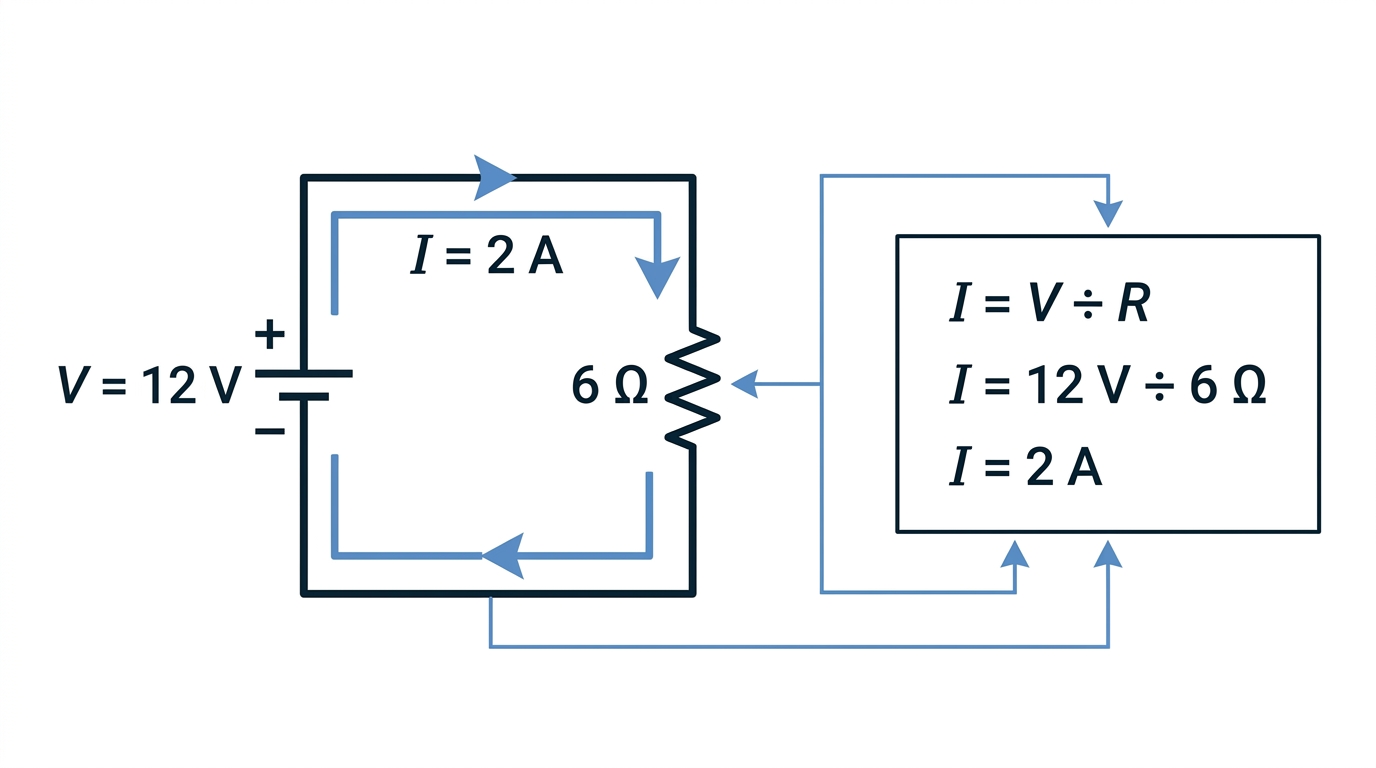
Given
- Voltage = 12 V
- Resistance = 6 Ω
Use:
Therefore, the current is 2 A.
Example 2: Calculate Resistance
Consider a circuit supplied by 24 V with a current of 3 A. What is the resistance?
Therefore, the resistance is 8 Ω.
Example 3: Calculate Voltage
A circuit carries 5 A through a 10 Ω resistive load. What voltage is required?
Therefore, the required voltage is 50 V.
Ohm's Law Calculation Table
| Known Values | Formula | Quantity Calculated |
|---|---|---|
| Current + Resistance | V = I × R | Voltage |
| Voltage + Resistance | I = V ÷ R | Current |
| Voltage + Current | R = V ÷ I | Resistance |
Ohm's Law and Electrical Power
Ohm's Law can be combined with the electrical power equation to derive several useful relationships.
Substituting the Ohm's Law relationships gives:
These relationships are commonly used in circuit calculations, resistor power calculations, equipment analysis and electrical design.
Applications of Ohm's Law
Ohm's Law is used throughout electrical and electronic engineering.
- Electrical circuit analysis
- Cable and conductor calculations
- Voltage-drop calculations
- Resistor selection
- Power calculations
- Electrical troubleshooting
- Electronic circuit analysis
- Basic solar PV calculations
Limitations of Ohm's Law
Ohm's Law is extremely useful, but it does not describe every electrical device under every operating condition.
Some components have nonlinear voltage-current characteristics. Their effective resistance can change as voltage, current, temperature or other operating conditions change.
Examples include semiconductor devices such as diodes and many electronic components.
Frequently Asked Questions
What is Ohm's Law?
Ohm's Law describes the relationship between voltage, current and resistance using V = I × R.
What is the formula for current?
Current is calculated using I = V ÷ R. Voltage is divided by resistance.
What is the formula for resistance?
Resistance is calculated using R = V ÷ I.
Can Ohm's Law be used for every electrical device?
No. Many devices are non-ohmic and do not have a constant resistance over all operating conditions.
What are the units used in Ohm's Law?
Voltage is measured in volts (V), current in amperes (A), and resistance in ohms (Ω).
Summary
Ohm's Law provides a fundamental relationship between voltage, current and resistance.
From this equation, voltage, current or resistance can be calculated when the other two values are known.
Understanding Ohm's Law provides a foundation for more advanced electrical topics such as power, voltage drop, circuit analysis, equipment calculations and electrical system design.