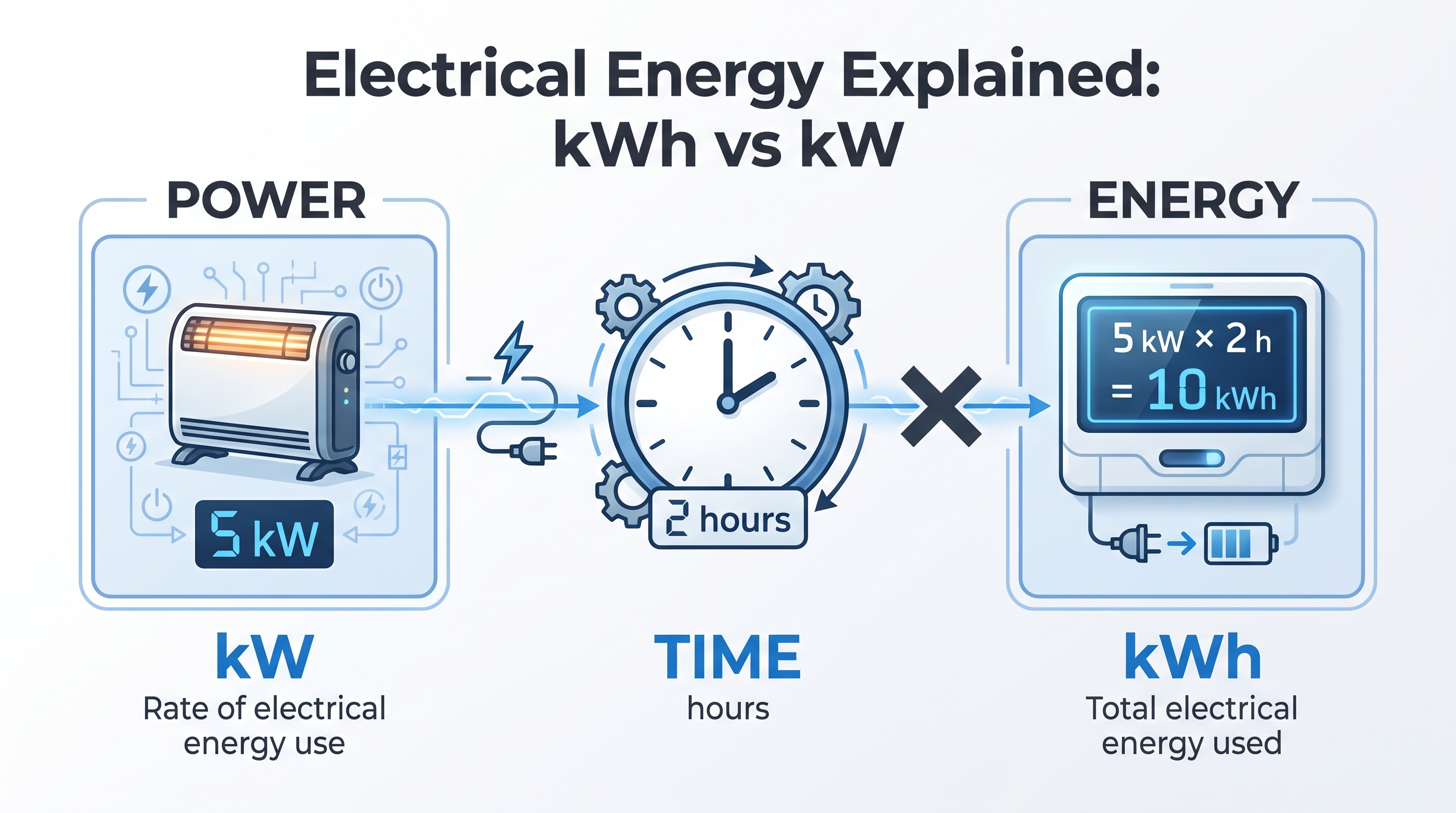
Electrical energy is one of the most important concepts in electrical engineering. It describes the amount of electrical work performed or energy transferred or consumed by an electrical device over a period of time.
Two units are commonly confused when discussing electrical systems: kilowatt (kW) and kilowatt-hour (kWh). Although they are related, they describe different physical quantities.
Understanding the difference between kW and kWh is important when working with electrical loads, generators, batteries, solar PV systems and electricity bills.
What Is Electrical Energy?
Electrical energy is the energy transferred when electrical systems deliver, consume or convert electrical power over time.
For a device operating at a constant power level, electrical energy can be calculated from its power and operating time.
If power is measured in kilowatts and time is measured in hours, the resulting energy is measured in kilowatt-hours (kWh).
Electrical Power vs Electrical Energy
Power and energy are closely related, but they are not the same physical quantity.
| Quantity | Meaning | Common Unit |
|---|---|---|
| Power | Rate at which electrical energy is transferred or used | W or kW |
| Energy | Total electrical energy transferred or consumed over time | Wh or kWh |
A simple way to understand the difference is to think of power as the rate and energy as the accumulated amount.
What Is a Kilowatt (kW)?
A kilowatt is a unit of power. One kilowatt is equal to 1,000 watts.
For example, an electrical heater rated at 2 kW requires approximately 2 kW of electrical power while operating at its rated condition.
Similarly, a 5 kW solar inverter can deliver up to approximately 5 kW of AC power under suitable operating conditions.
What Is a Kilowatt-hour (kWh)?
A kilowatt-hour is a unit of energy. It represents the amount of energy used or produced when a 1 kW power level is maintained for one hour.
Therefore, if a 1 kW load operates continuously for 1 hour, it consumes 1 kWh of electrical energy.
kW vs kWh: What Is the Difference?
| kW | kWh |
|---|---|
| Unit of power | Unit of energy |
| Measures the rate of energy use | Measures total energy used |
| Does not directly include time | Includes time |
| Example: 5 kW load | Example: 20 kWh consumed |
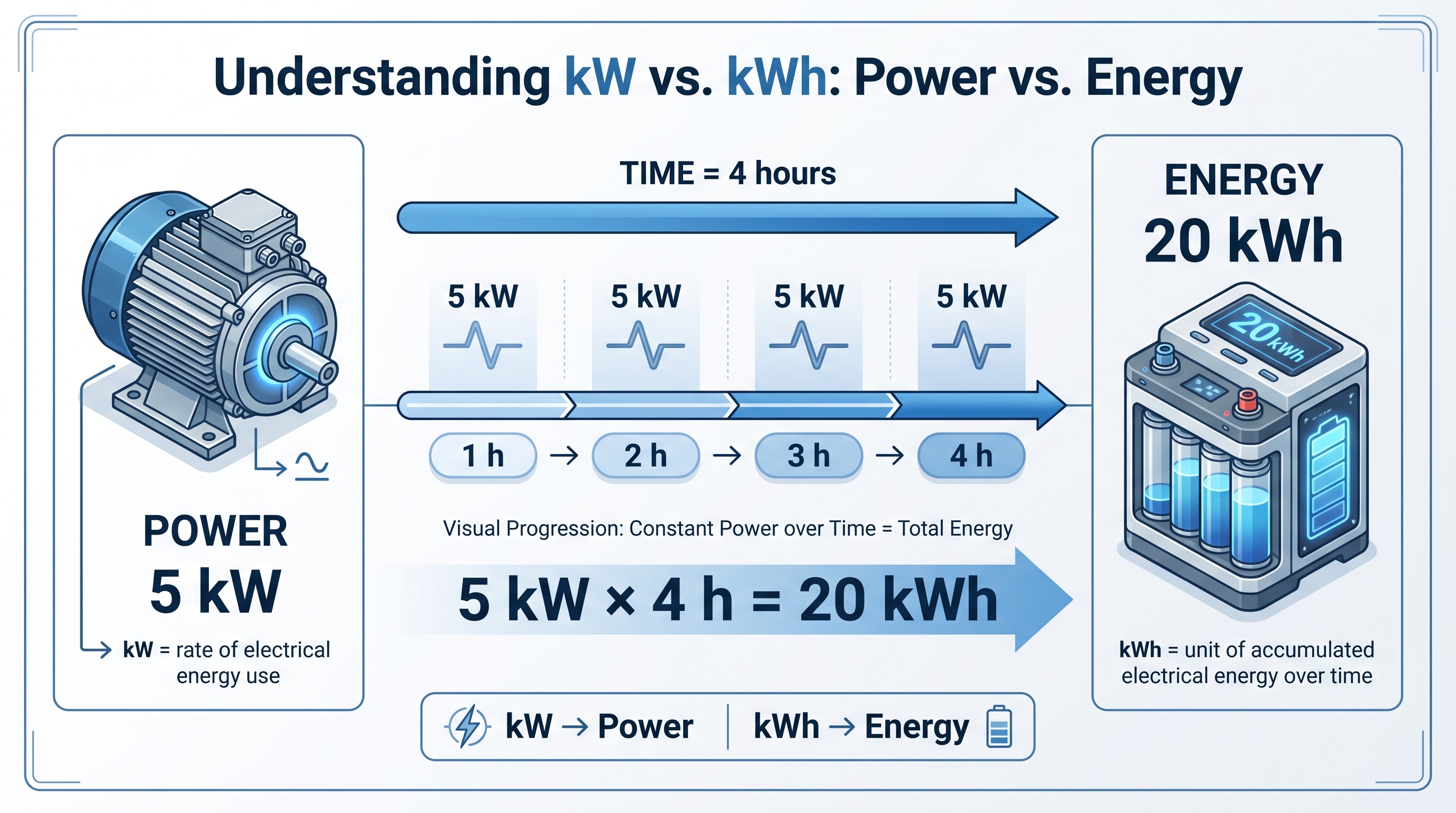
The easiest way to remember the difference is: kW tells you the power level, while kWh tells you how much energy has been used or produced over time.
Electrical Energy Calculation Formula
When power is expressed in kilowatts and time is expressed in hours, electrical energy can be calculated using:
If the power is given in watts, convert it to kilowatts before using the formula.
Practical Examples
Example 1: Energy Consumption of a 1 kW Load
Consider a 1 kW electrical load operating for 6 hours.
Operating time = 6 hours
Calculation: E = P × t
E = 1 × 6
E = 6 kWh
Therefore, the load consumes 6 kWh of electrical energy during the six-hour operating period.
Example 2: A 2 kW Heater Operating for 5 Hours
Suppose a 2 kW electric heater operates for 5 hours per day.
Time = 5 hours
Calculation: E = P × t
E = 2 × 5
E = 10 kWh
The heater therefore consumes approximately 10 kWh per day when operating at a constant 2 kW power level for five hours.
Example 3: Converting Watts to kWh
Consider a 500 W electrical appliance operating for 8 hours.
First convert the power from watts to kilowatts:
Now calculate the energy:
Therefore, the appliance consumes approximately 4 kWh during eight hours of operation.
How kWh Is Used on an Electricity Bill
Electricity consumption is commonly measured in kilowatt-hours. Your electricity meter records the electrical energy consumed over time.
For example, if a household consumes 350 kWh during a billing period, the energy consumption for that period is 350 kWh.
If the applicable electricity energy charge were $0.15 per kWh, the energy portion of the bill would be:
kW and kWh in Solar PV Systems
The difference between kW and kWh is particularly important in solar photovoltaic systems.
Solar PV system capacity is commonly expressed in kW or kWp, while the electrical energy generated by the system is commonly expressed in kWh.
For example, a solar PV system with a rated capacity of 10 kWp is a power-capacity description. It does not mean that the system produces 10 kWh every hour under all conditions.
Actual solar energy production depends on factors such as solar irradiance, module temperature, system losses, inverter operation, shading and the available solar resource.
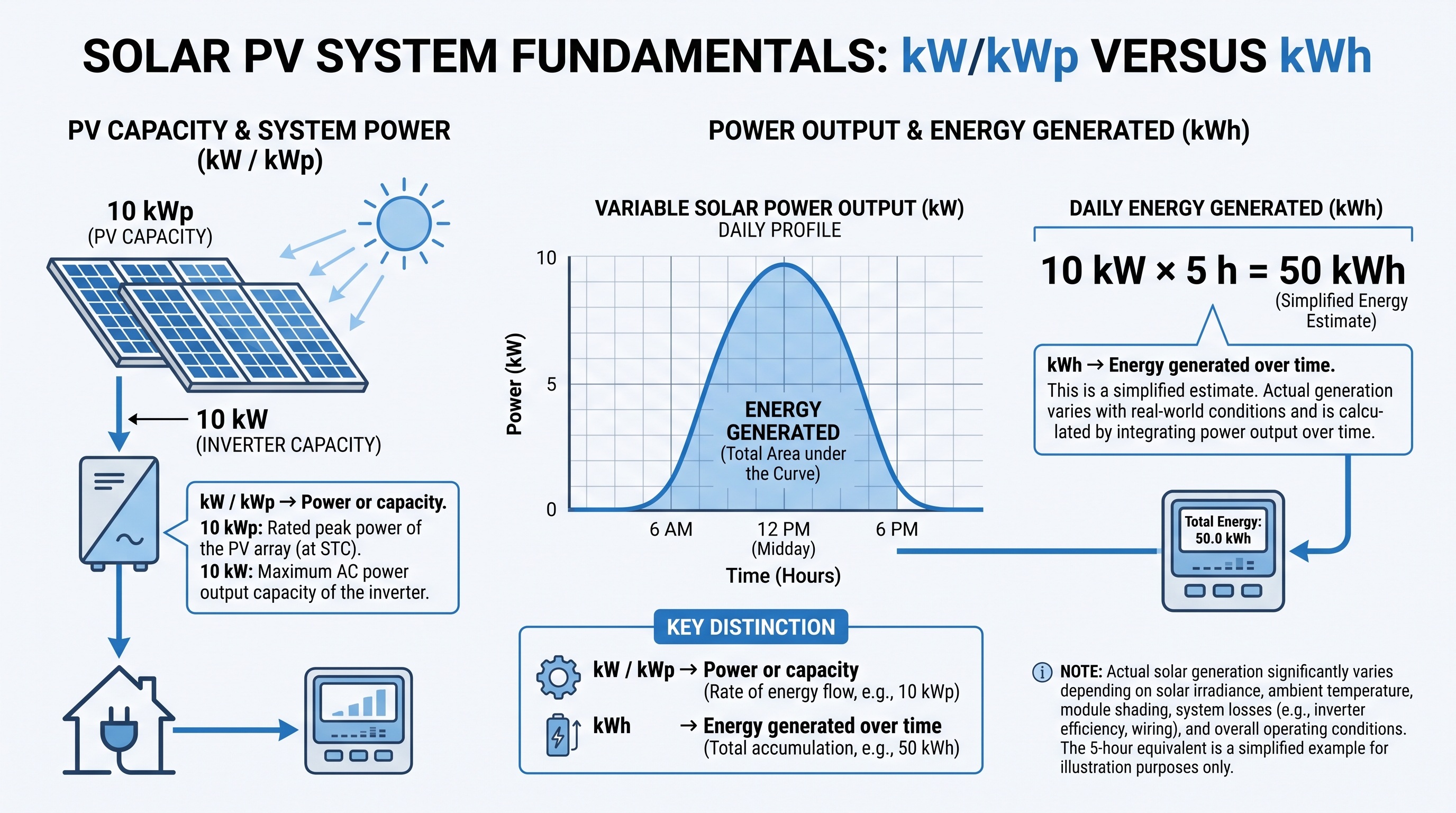
E = 10 kW × 5 h
E = 50 kWh
Actual production will vary depending on system conditions and losses.
Electrical Energy in Three-Phase Systems
In a balanced three-phase system, active electrical power can be calculated from line voltage, line current and power factor.
When voltage and current are expressed in volts and amperes, the calculated active power is in watts. Dividing by 1,000 converts watts to kilowatts.
Once the power in kW is known, energy can be calculated using the operating time:
Common kW and kWh Mistakes
Several common mistakes occur when discussing electrical power and energy.
- Treating kW and kWh as interchangeable units.
- Forgetting to convert watts into kilowatts.
- Calculating energy without considering operating time.
- Assuming a solar PV system operates at its rated power throughout the entire day.
- Confusing electrical power capacity with total energy production or consumption.
Quick Reference: kW and kWh
| Term | Meaning | Example |
|---|---|---|
| W | Watt — unit of power | 500 W appliance |
| kW | Kilowatt — unit of power | 5 kW motor |
| Wh | Watt-hour — unit of energy | 500 Wh |
| kWh | Kilowatt-hour — unit of energy | 20 kWh consumed |
Summary
Kilowatt (kW) and kilowatt-hour (kWh) describe two different electrical quantities.
kW measures power , which represents the rate at which electrical energy is transferred or used.
kWh measures energy , which represents the total amount of electrical energy consumed or produced over a period of time.
Remembering this relationship makes it much easier to understand electrical loads, electricity consumption, solar PV generation and energy calculations.
Frequently Asked Questions
What is the difference between kW and kWh?
kW is a unit of power and describes the rate of energy use or production. kWh is a unit of energy and describes the total energy used or produced over time.
How do you calculate electrical energy?
For a constant power load, electrical energy can be calculated using E = P × t . When power is in kW and time is in hours, the result is kWh.
Is kW the same as kWh?
No. kW measures power, while kWh measures energy. For example, a 5 kW load operating for 2 hours consumes 10 kWh.
What does kWh mean on an electricity bill?
kWh represents the amount of electrical energy consumed during the billing period.
Is kWp the same as kWh?
No. kWp is commonly used to describe the rated peak capacity of a solar PV system, while kWh describes electrical energy generated or consumed over time.